Order Trichoptera
Family Hydropsychidae
Genus Cheumatopsyche
Species campyla

Pronounced - chum muh to si kee - cam pee luh
Common Name - Little Sister Sedge
Size
Hook - Green variety 20, 22. Brown or dark tan variety 24.
Millimeter - Green variety 9.5 to 11. Brown or dark tan variety 7 to 8.
Type - Common net spinner
Case Type - None
Adult
Body Color - Green abdomen with a tan to dark tan thorax.
Wing Color - Medium Dun, when freshly hatched wings are light to medium dun with a yellowish stain on the wings basal section.
Forty-three species are presently recorded in North America (Morse 1993).
Cheumatopsyche larvae spin silk into nets not unlike a spider spins a web to collect insects.
Cheumatopsyche feed upon plant particles, smaller insects, and debris collected in their nets from the flowing water.
Cheumatopsyche larvae don't build cases, but build a retreat near their nets camouflaged with small gravel, and plant debris. As their final instar approaches they seal themselves inside their retreat, and begin the transformation from larva to pupa.
C. campyla produce good fishable hatches, with fish keying in on them during emergence, and egg laying, but seem to prefer fair weather for both activities.
This is a very confusing species, here color seems to be an issue. As a general rule insects of one species are uniform in coloration within a geographical region. Although it's common for a slight difference in coloration from season to season with any aquatic insect, this difference is nominal. Most aquatic insects differ in color between male and female of the same species, here again not the case. Cheumatopsyche vary color within the same species.
To explain I'll need to go back to the beginning of this program. I didn't just go out and collect insects randomly, I targeted specific insects that were important. Caddis that I fished regularly from season to season were at the top of the list. This list included a small green caddisfly named Cheumatopsyche. As I collected these another smaller caddis was also on the water. This was a different color and size, 22 to 24, dark or dirty tan, to dark brown in color. Wondering what they were, but not thinking much about it I collected one or two, and put them away for further study at a future date.
As I began keying out the green variety, I immediately became overwhelmed with the vast number of species within this genus. The keys kept leading me to C. campyla. Ok now I began looking at fly fishing literature, and hatch charts for clues to support my determination. Here is where the confusion set in, some listed C. campyla as being dark, the usual color listed was brown, others listed it as green. At this point I decided to look at the smaller dark caddis. Once again the keys kept leading me back to C. campyla, my first thought was, I must have made a mistake while keying out the green variety. So, back to the green specimen, no still C. campyla. Since these specimens were both males the only explanation must be that these seemingly different insects that vary drastically in color are both be C. campyla.
C. campyla prefer larger rivers, and is the most widespread species of Cheumatopsyche in the Nearctic region. Out of the dozen or so species known in the upper Delaware area C. campyla seems to be the most important to fly fisherman, especially those fishing the main stem, and lower east branch.
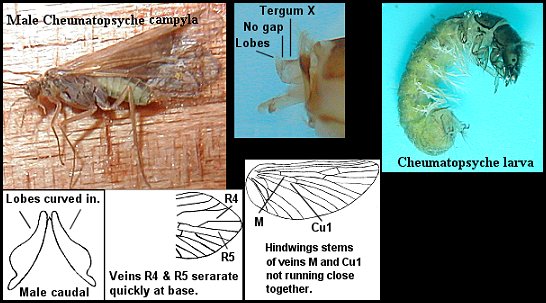
Key to Family - Ocelli absent. One large wart on scutellum. Both male and female maxillary palps are five segmented, segment five is long, flexible, and whip like. Legs - spurs foreleg 2, middle 4, hind 4.
Key to Genus - Veins R4 and R5 of forewings separateing quickly at their base. Stems of M and Cu veins of hindwings seperating quickly from base, not running parallel throughout their length.
Key to Species - C. campyla - Male, lateral view, lobes of tergum X extended above tergum with no gap between them. Caudal view, lobes of tergum X are rounded on the tips and concaved for better than half of their length. Modified from, Moulton and Johnson - 1996 - Interior Highlands Trichoptera Memoirs of the American Entomological Institute 56.
Jerry Hadden's Guide Service
Fly fishing float trips for wild trout on the Upper Delaware River.
607-221-4282