Order Trichoptera
Family Limnephilidae
Genus Apatania
Species nigra

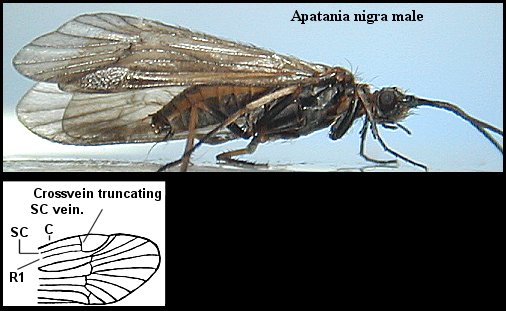
Pronounced - ah pa tay knee uh - nig er uh
Common Name - Smokey Wing Sedge, Black Caddis
Size
Hook - 20, 22
Millimeter - 8 to 8.5
Type - Nothern case maker
Case Type - Stone tube like consisting of small stone.
Adult
Body Color - Thorax is very dark brownish gray to black, abdomen is very dark brownish gray with a tan lateral stripe.
Wing Color - Light to medium dun with a tanish tinge.
Like any small dark caddisfly Apatania is consistently mistaken for Chimarra. Almost every hatch chart on the upper Delaware system lists Chimarra hatching between early April and late May. This confusion stems from labeling any small dark caddis found flying around the river Chimarra instead of taking a closer look. Upon closer examination most of the small dark caddis that I've collected during this time period where in fact Apatainia. Contributing to the confusion is the fact that most documentation on Apatania lists them as preferring small streams. This seems to be correct pertaining to the upper Delaware area with one important difference, they seem to spread out into the river from the mouths of feeder streams. Hundreds of cased pupa can be found in the river in these locations. Adults have also been collected flying over the river a good ways away from any feeder streams.
A. nigra is the most abuntant species of this genus in the river system. The more commonly known A. incerta, and the lesser know A. praevolans are also present in the area. All three species hatch within the same time period, and are so close in appearance their differences aren't of a great importance to the fly fisher.
What is important to fly fisherman is the fact that Apatania are active very early in the season, when food is generally sparse. They crawl along the stream bottom with their case in tow exposed to hungry trout. Many trout have been found to have a stomach full of Apatania larva, cases included! Here a cased larva imitation fished on the bottom becomes important.
Key to Family - Ocelli present. Scutellum cointains two small separated warts. Maxillary palps of male three segmented with segment one very short, segments two and three long, females have five segments. Legs - Spines are present and well developed, spurs range from foreleg 1, middle 3, hind 4, to foreleg 1, middle 1, hind 1.
Key to Genus - Forewing not much wider than hind. Forewing veins R1 and C joined by a crossvein that truncates SC.
Jerry Hadden's Guide Service
Fly fishing float trips for wild trout on the Upper Delaware River.
607-221-4282