Order Trichoptera
Family Lepidostomatidae
Genus Lepidostoma
Species togatum

Pronounced - lep ee dos to muh - toe ga tum
Common Name - Little Plain Brown Sedge
Size
Hook - 20, 22
Millimeter - 9 to 9.5
Type - Tube case maker
Case Type - The typical case is four sided (log cabin type), and made from small pieces of wood, and vegetation. It's easily distinguished from the case of Brachycentrus by the irregular shaped pieces of material used for construction. Some species construct different types of cases from different types of material during different growth periods, or instars.
Adult
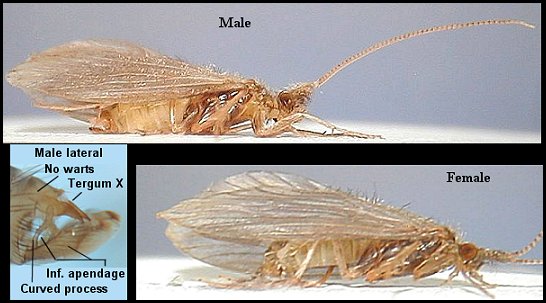
Body Color - Male has a tanish yellow to pale tanish yellow abdomen with a tan thorax. Females have a tan thorax, and an abdomen that's pale tanish yellow with a greenish tinge.
Wing Color - Light to medium dun with a tanish to brown tinge.
Of the seventy species in the Lepidostoma genus L. togatum is the most wide spread species in North America (Weaver 1988).
Lepidostoma togatum are important not for large hatches, but for the length of time they hatch during the season. Although you never find more that a half dozen or so on the river at a time fish eagerly feed upon them as they drift for long distances after reaching the surface. Hatch activity begins in the late morning, early afternoon, and continues into the early evening.
Like many other caddis freshly hatched L. togatum duns display a yellowish stain at the basal section of their wings. This coloration fades away as the wings darken slightly after being exposed to the air for a period of time.
As I began studying caddis closer for the purpose of writing this, this yellowish stain puzzled me at first. Then it hit me, pretty much all caddis that I've found that were still stuck in their husk the membrane was either yellowish or dark amber. Could this stain be left over from the pupa's membrane? My question was answered one day when I was able to collect a caddis fully emerged from it's husk, but still had a piece stuck to it's wing. This piece of membrane was in the exact place at the basal section of the wing, and the same color as the stain.
Key to Family - Ocelli absent. Both scutum and scutellum have two warts. (See picture for position and size. Also note wart pattern on pronotum and head.) First or second segment of male antenna is thick and long, forked or non-forked, and covered with thick hair. First segment of female antenna long, and non-forked, and covered with thick hair. Spurs foreleg 2, middle 4, hind 4.
Key to Genus - Segment IX has no dorsal warts. Male maxillary palps two segmented, and covered with thick hair, held curled under mandible. Female maxillary palps five segmented.
Key to Species - L. togatum - Male, segment one of inferior appendages are large, and have a curved finger like process located anteriorly. Tergum X is horn like and curved down. Modified from, Moulton and Johnson - 1996 - Interior Highlands Trichoptera Memoirs of the American Entomological Institute 56.
Jerry Hadden's Guide Service
Fly fishing float trips for wild trout on the Upper Delaware River.
607-221-4282